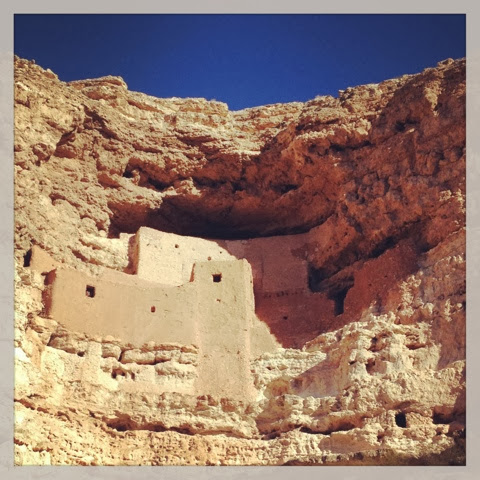
This is the main building that remains--not huge, but well-preserved. And the ancient peoples who lived here picked a gorgeous place to live--and we were lucky enough to visit before all the sycamore trees had lost their golden leaves.
Showing posts with label history. Show all posts
November 14, 2013
Our Fall Adventure, Part 2: Montezuma's Castle National Monument
I remembered stopping by this beautifully set cliff dwelling when I was a little girl traveling through Arizona--and I was pleased to find it as simple and lovely as I remembered.
August 20, 2012
October 10, 2011
Just In Case; or, Fun with 500; or, Everyone's Doing It
Just in case Mr. Cool ever becomes president, I have a very first-lady-ish hobby going.

There are dozens of photos of Eleanor knitting. She was always knitting. Especially on planes. It would be amusing to see her deal with the TSA today about her knitting needles.

This is Grace Coolidge, wife of Calvin Coolidge, for those of you who didn't automatically recognize her. She loved to knit as well. She also crocheted--including a coverlet for the Lincoln Bedroom.
In fact, as I celebrate my 500th post on this blog, loads of people love to knit (or at least pretend.) Check it out!
September 01, 2010
The Problem with Education, a Mini-Rant: Or, the Gettysburg Casino
This will be quick, as Linc and I are busy filling cups with things, dumping them out, and then refilling them. It's a busy day.
Several things have happened recently in my reading/viewing/listening that have made me mad at America, education in America, and Americans in general, which may be a bit harsh.
Item One: There are plans to put a casino near the Gettysburg battlefield, where 50,000 Americans died in three days. Some people support it, because it will provide jobs. One opponent made the excellent argument that we would not appreciate it if France put a casino at Normandy. However, how many people really know what happened at Gettysburg, other than Lincoln's address? When I taught it two years, I only had two HS freshman who could accurately tell me what year the Civil War took place in--two out of 140.
Item Two: Every single one of our current supreme court justices was educated at an Ivy League school. This makes me angry, because after reading up/watching up on the Nuremberg trials this summer, I know that Robert Jackson, the US Supreme Court Justice who prosecuted the trials, did not attend college. He read law, and apprenticed, much as Abraham Lincoln did. We don't do that any more. Education in the United States is too strictly regulated. We don't approach learning as its own joy and glory, but merely as a means to make more money.
Item Three: Colorado and other states keep working to get rid of "bad" teachers in order to improve education. I know that there are bad teachers, but do you turn on the radio every day to hear about the country getting rid of "bad" graphic designers, bankers, ranchers, doctors? No. Maybe we need to really consider how to help teachers be good, like class size. As many states cut education budgets drastically, though, this is likely not to happen. I firmly believe that if every classroom had less than 20 students (aside from band/choir and other specialty things), education would improve.
My biggest goal for my son is to teach him that learning and curiosity are a constant joy. Samuel Johnson said that he who is tired of London is tired of life, but I would say he who is tired of learning is tired of life. I guess my son will also learn that mama likes to rant.
April 25, 2010
The Moon and The Skylight: The Loss of American Imagination
This beautiful skylight is the hand-painted highlight of the Painted Desert Inn, located in Petrified Forest National Park. The Inn and the skylight were created by the CCC.I have been in the middle of a re-read of Carrying the Fire, Michael Collins' brilliant book on his role in the Apollo program. After reading it, I re-read a few portions of Andrew Chaikin's equally brilliant A Man on the Moon. All this comes after a visit to the Painted Desert Inn, a beautifully restored gem in Petrified Forest National Park. The Inn was renovated and decorated by the Civilian Conservation Corps, one of FDR's ingenious ideas for putting young men to work during the Depression. Not only were they put to work re-building an historic inn, but they were allowed to use their artistic expression--painting the skylight, designing tin lamps, and as Coloradoans know, painting murals.
With all these ideas swirling in my head, I read the end of Chaikin's book:
Recently, the continued exploration of the moon has been back in the spotlight--President Obama has issued his recommendations for NASA's future and been confronted by former astronauts.
All of these issues, ideas, and irritants have forced a single idea into my head--we have lost our national imagination. When confronted with an economic downturn, we offer people money for clunker cars, fueling the idea that conspicuous consumption can save us, rather than offering people jobs rebuilding and creating new landmarks and art. When confronted with the future of the Space Program, we choose to borrow Russia Soyuz (built around the time of the Apollo CM and LM) to fly, rather than put our imaginations to work to create a new vessel for exploring the skies.
We have, as Chaikin says, lost our national vision. Politicians are focused on the present, on the now, on what will get them votes. That has been true throughout time, but in my limited study, politicians also used to focus on what would happen in the future--John Adams wanted a Navy even though the US wasn't at war, FDR wanted to give all young men honest jobs, even artists, JFK wanted to inspire American to achieve the unbelievable. Whatever your thoughts and feelings on Kennedy, what cannot be denied is his imagination and inspiration, especially contained in his famous speech at Rice University in 1961:
Politicians, legislators, public leaders--they are choosing to do things because they are easy, not because they are hard. In this present-minded focus they are neglecting not only the future, but the past. There are still starving artists out there who could be put to work making our country beautiful for the future. There are still young people focused on science and exploration--there may be no frontiers left on land, but there are still frontiers to be explored in space and sea.
Healthcare is important. Jobs are important--but outside of war, FDR's new deal and JFK's moon mission spring to mind as peaceful ways to put people to work. Yes, travelling to the moon cost billions of dollars, but billions of dollars flowing to American workers, not Chinese.
This has been a bit of a rambling rant, and if you actually read this far, you must be related to me. I have no solutions, or challenges. I do not have the ear of any great leaders. I wish only for America to rediscover its drive, its ambition, its imagination. I want us to paint murals in city buildings. I want us to fly to the moon, or Mars, or even Venus. I want our focus to leave the now, leave ourselves, and create something for the future.
Perhaps I am challenged by this because of some simple dates--I was born ten years after the first moon landing, and my son was born forty years after that historical event. What have we done since? Disco? MTV? The iPod?
With all these ideas swirling in my head, I read the end of Chaikin's book:
Instead of letting the moon be the gateway to our future, we have let it become a brief chapter in our history. The irony is that in turning away from space exploration--whose progress is intimately linked to the future of mankind--we rob ourselves of the long-term vision we desperately need. Any society, if it is to flourish instead of merely survive, must strive to transcend its own limits. It is still as Kennedy said: Exploration, by virtue of difficulty, causes us to focus our abilities and make them better.
Recently, the continued exploration of the moon has been back in the spotlight--President Obama has issued his recommendations for NASA's future and been confronted by former astronauts.
All of these issues, ideas, and irritants have forced a single idea into my head--we have lost our national imagination. When confronted with an economic downturn, we offer people money for clunker cars, fueling the idea that conspicuous consumption can save us, rather than offering people jobs rebuilding and creating new landmarks and art. When confronted with the future of the Space Program, we choose to borrow Russia Soyuz (built around the time of the Apollo CM and LM) to fly, rather than put our imaginations to work to create a new vessel for exploring the skies.
We have, as Chaikin says, lost our national vision. Politicians are focused on the present, on the now, on what will get them votes. That has been true throughout time, but in my limited study, politicians also used to focus on what would happen in the future--John Adams wanted a Navy even though the US wasn't at war, FDR wanted to give all young men honest jobs, even artists, JFK wanted to inspire American to achieve the unbelievable. Whatever your thoughts and feelings on Kennedy, what cannot be denied is his imagination and inspiration, especially contained in his famous speech at Rice University in 1961:
"We choose to go to the moon! We choose to go to the moon in this decade and do the other things--not because they are easy, but because they are hard."
Politicians, legislators, public leaders--they are choosing to do things because they are easy, not because they are hard. In this present-minded focus they are neglecting not only the future, but the past. There are still starving artists out there who could be put to work making our country beautiful for the future. There are still young people focused on science and exploration--there may be no frontiers left on land, but there are still frontiers to be explored in space and sea.
Healthcare is important. Jobs are important--but outside of war, FDR's new deal and JFK's moon mission spring to mind as peaceful ways to put people to work. Yes, travelling to the moon cost billions of dollars, but billions of dollars flowing to American workers, not Chinese.
This has been a bit of a rambling rant, and if you actually read this far, you must be related to me. I have no solutions, or challenges. I do not have the ear of any great leaders. I wish only for America to rediscover its drive, its ambition, its imagination. I want us to paint murals in city buildings. I want us to fly to the moon, or Mars, or even Venus. I want our focus to leave the now, leave ourselves, and create something for the future.
Perhaps I am challenged by this because of some simple dates--I was born ten years after the first moon landing, and my son was born forty years after that historical event. What have we done since? Disco? MTV? The iPod?
November 11, 2008
Medal of Honor: A Veteran's Day Post
Last week, Mr. Cool and I stayed up late watching a documentary on PBS on the Medal of Honor and its recipients. Mr. Cool knows he can always suck me in to anything military as long as they mention the Civil War. It was fascinating, and we spent a good deal of time this weekend reading about the Medal of Honor. I learned about some amazing men and women who have served our country above and beyond, and I wanted to quickly share some of my favorite honorees.

Tibor Rubin, a Hungarian immigrant, was placed in a Nazi concentration camp at the age of 13, until liberated by American troops. He wanted to go to the U.S. to become a G.I. Joe, and although he struggled with the language test, eventually made it. He served in Korea, under an anti-Semitic commander who tried to kill him. Unfortunately, he was just too darn good at soldiering. He was later taken captive and held as a prisoner of war, where he stole food for his fellow captives and worked hard to domitzvahs (good deeds) as his late mother had taught him.
The other story that shocked and surprised me involved Admiral Stockdale. Yes, the same Admiral James Stockdale who served as Ross Perot's running mate in the 1992 election and famously said, "Who am I? Why am I here?" at the VP debate. He has been the butt of many jokes ever since, when in reality his Medal of Honor citation is incredible. I find I must quote it, rather than trying to re-tell the story:
I'll close this rather long post with a quote:
Tibor Rubin, a Hungarian immigrant, was placed in a Nazi concentration camp at the age of 13, until liberated by American troops. He wanted to go to the U.S. to become a G.I. Joe, and although he struggled with the language test, eventually made it. He served in Korea, under an anti-Semitic commander who tried to kill him. Unfortunately, he was just too darn good at soldiering. He was later taken captive and held as a prisoner of war, where he stole food for his fellow captives and worked hard to domitzvahs (good deeds) as his late mother had taught him.
Citation: For conspicuous gallantry and intrepidity at the risk of his life above and beyond the call of duty while senior naval officer in the Prisoner of War camps of North Vietnam. Recognized by his captors as the leader in the Prisoners' of War resistance to interrogation and in their refusal to participate in propaganda exploitation, Rear Adm. Stockdale was singled out for interrogation and attendant torture after he was detected in a covert communications attempt. Sensing the start of another purge, and aware that his earlier efforts at self-disfiguration to dissuade his captors from exploiting him for propaganda purposes had resulted in cruel and agonizing punishment, Rear Adm. Stockdale resolved to make himself a symbol of resistance regardless of personal sacrifice. He deliberately inflicted a near-mortal wound to his person in order to convince his captors of his willingness to give up his life rather than capitulate. He was subsequently discovered and revived by the North Vietnamese who, convinced of his indomitable spirit, abated in their employment of excessive harassment and torture toward all of the Prisoners of War. By his heroic action, at great peril to himself, he earned the everlasting gratitude of his fellow prisoners and of his country. Rear Adm. Stockdale's valiant leadership and extraordinary courage in a hostile environment sustain and enhance the finest traditions of the U.S. Naval Service.I hope today you will take a chance to learn about the many Medal of Honor recipients, including Vernon Baker, originally from Cheyenne, WY, "Hershey" Miyamura, raised in New Mexico, and the four heroes from Pueblo, CO. And, if you really are a Civil War nerd like me, reading the various citations from the Civil War is a great way to kill some time. Of course, thanks to any and all veterans who read this blog, and a special thanks to my family who has served in the military: my Grandpa Bill, my father-in-law George, and my brother-in-law Matthew.
I'll close this rather long post with a quote:
"We sleep soundly in our beds because rough men stand ready in the night to visit violence on those who would do us harm." ~Winston Churchill (Mr. Cool's oft-quoted quote)
Subscribe to:
Posts (Atom)


